

You want to invest in a leather accessory, but you're not sure you fully understand the difference between one type of leather and another.
No need to panic, at JULES & JENN we have a real passion for leather and beautiful materials, and we're going to enlighten you on the subject!
We're sure you've already felt helpless when faced with a salesperson praising a bag made of " full-grain leather " or " vegetable-tanned leather "? Even if the bag seems like a simple product, our knowledge in this area sometimes struggles to keep up…
To help you find your future purchase, JULES & JENN offers a brief overview of the different types of leather, tanning processes, and appellations, giving you a (slightly) clearer understanding so you can buy consciously!
Leather, a noble material
"Leather" is the result of transforming an animal's hide, which becomes rot-proof through the tanning process. Primarily used in clothing, decoration, and saddlery, leather comes in a multitude of forms. But be aware that there are several types of leather, each with its own characteristics.Apart from exotic leathers – which come from animals raised specifically for their hides – all leathers come from animals raised for their meat or milk.
Calfskin leather comes from six-month-old calves. For this reason, their hides are particularly fine and have fewer imperfections than those of adult animals. Generally, it is a naturally smooth leather.
Cowhide leather comes from young cows, and is also rather smooth.
Buffalo leather is a very durable leather, more commonly used for sofas, travel leather goods, or shoes. It is recognizable by its thickness and natural grain, with a veined appearance.
Bull calf leather comes from young bulls. With a finer grain, it is highly prized for its few imperfections while remaining quite durable. It is notably used in the manufacture of high-end leather goods.
Goatskin provides a supple, durable, slightly grainy leather. It can be made into bags, shoes, gloves, or bookbinding. Its exceptionally soft feel makes it ideal for high-quality shoe linings and soles.
Lambskin is the most delicate leather and the silkiest to the touch. And the smaller the animal, the more supple the skin.


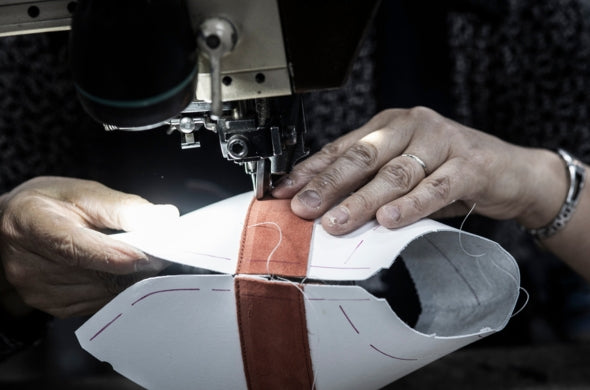
The different types and colours of leather in our workshop in Porto, Portugal.
Leather & traceability
Today, consumers are increasingly concerned about the origin of the products they are about to buy. Extending beyond the food industry, this phenomenon is gaining momentum in fashion. Consumers want greater transparency : they want to make informed purchases.When it comes to leather, everything that happens in an animal's life is visible on its hide: the scar from a snag on barbed wire, the small holes caused by disease, the deep wrinkles of malnutrition, and so on. In Europe, therefore, farmers and transporters are being made aware of these issues. They are encouraged, for example, to vaccinate their animals against ringworm, in order to limit its impact on the animal's weight and the quality of its hide.
Leather tanning
Tanning is the process that transforms animal hides into durable leather.After selecting their hides, the tanners, who process the larger hides—calf, cow, buffalo, bull calf—and the leather dressers, who process the smaller hides—goat, lamb, exotic skins—move on to the cleaning stage. They soak the hides—a process known as "river work"—removing the hair and excess material. Then comes the actual tanning process, which will make the leather rot-proof. Following the same principle as a washing machine, the hides rotate with water and tanning agents in large drums called fulling vats. Finally, the hides must dry in drying ovens or in the open air, according to the more traditional method.
What is vegetable tanning of leather?
There are 2 tanning techniques: mineral tanning using chemicals, such as chromium salts, and vegetable tanning, using plant substances, such as Quebracho bark. Vegetable tanning is a process inspired by nature and respects the environment. Vegetable-tanned leather contains no toxic substances harmful to humans. The use of natural tannins in leather processing ensures a low environmental impact. Like all leathers, vegetable-tanned leather can be recycled.
Vegetable-tanned leather, a unique material
The signs of time reveal the true nature of leather. The tannins give the leather a warm tone, becoming increasingly lustrous with age. Like a fine wine, vegetable-tanned leather matures over time, absorbing the marks of life. However, this natural aging does not compromise the leather's strength; quite the opposite: the resulting leather is harder and much less supple than mineral-tanned leather. Ideal for making belts, this is the option we naturally chose for JULES & JENN belts.
Vegetable tanning and mineral tanning
Mineral tanning accounts for 85% of global production because the tanning process is faster. Transforming a hide into leather takes only a few days using chromium salts, whereas it takes 30 days to tan leather with vegetable substances. Furthermore, mineral tanning produces more supple leathers and offers a much wider range of colors than vegetable tanning , which is limited to natural and dark shades.The choice of tanning process therefore depends on the intended purpose and the desired feel of the leather for the product. For example, vegetable-tanned leather cannot be used to make supple products or to achieve pastel colors.


Vegan leather, plant-based leather, what does it mean?
Vegan, by definition, means anything that has no animal origin. Hence the misuse of the term "vegan leather" or " plant-based leather "! This is especially true since the use of the word "leather" is regulated by decree 2010-29 of January 8, 2010, which stipulates that it is forbidden to use the word "leather" to refer to "any material other than that obtained from animal skin."But then, what exactly is "vegan leather," or rather, should we say "vegan material"?